
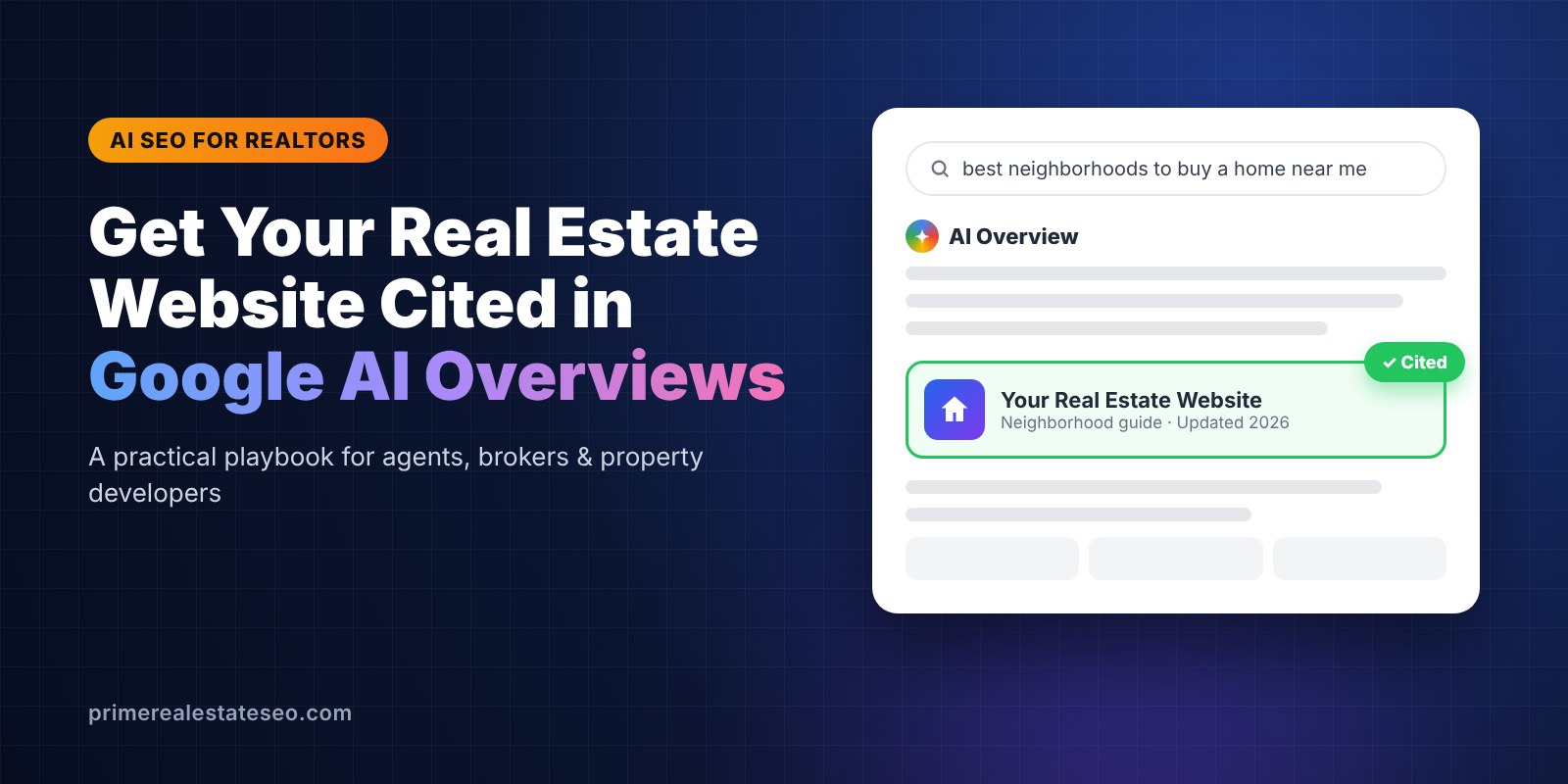
When a home buyer searches “best neighbourhoods for young families near me” or a seller asks “how much does it cost to sell a house?”, Google increasingly answers with an AI Overview, a generated summary at the very top of the results page, complete with links to the sources it relied on. Think of those cited links as the new prime real estate of search. So, if your brokerage or agent website is one of them, you earn visibility, credibility and clicks before a prospect ever scrolls to the classic blue links.
In this guide, we’ll explain how Google picks the sources for AI Overviews. Then, we’ll walk you through a practical, real-estate-specific playbook that helps your website earn more citations.
What Are Google AI Overviews?
Put simply, Google AI Overviews are AI-generated summaries that appear above organic results for many informational searches. They pull information from multiple web pages, combine it into a short answer and display source links alongside the summary. Google’s AI Mode, a more conversational search experience, works the same way and also links out to supporting pages.
Why does this matter for real estate businesses? Because a large share of property searches start with a question: buyers researching neighbourhoods, first-time buyers learning about mortgages, sellers comparing commission structures, and investors studying rental yields. And these are exactly the queries where AI Overviews tend to appear.
Why AI Overview Citations Matter for Real Estate Websites
- Top-of-page visibility: A citation places your brand above traditional listings and portal pages.
- Instant authority: When Google references your page, it signals that your content is trustworthy. That carries real weight in a high-value, trust-driven industry like property.
- Better-qualified traffic: Visitors who click through from an AI Overview have already read a summary, so they usually want deeper, local expertise.
- Competing with big portals: Hyperlocal, expert content gives independent agents a real chance to be cited alongside national property portals.
If you are new to the wider topic, our guide on how AI can help real estate agents generate more leads online is a helpful starting point.
How Does Google Choose Which Sites to Cite?
Google has stated in its Search Central documentation, AI features and your website, that it builds AI Overviews on its core ranking and quality systems. There is no separate “AI Overview tag” or secret markup. In practice, that means:
- Google must be able to index your page and show it with a snippet in Search.
- Standard SEO best practices still apply: crawlability, internal links, page experience and helpful content.
- Above all, Google says unique, helpful, reliable and people-first content matters most over time.
- Google has also said you don’t need special files such as llms.txt, and you don’t need to rewrite content “for AI” or chop pages into artificial chunks.
In short, you earn AI Overview visibility through excellent SEO and genuinely useful content, which is good news for agents who know their markets better than anyone else.
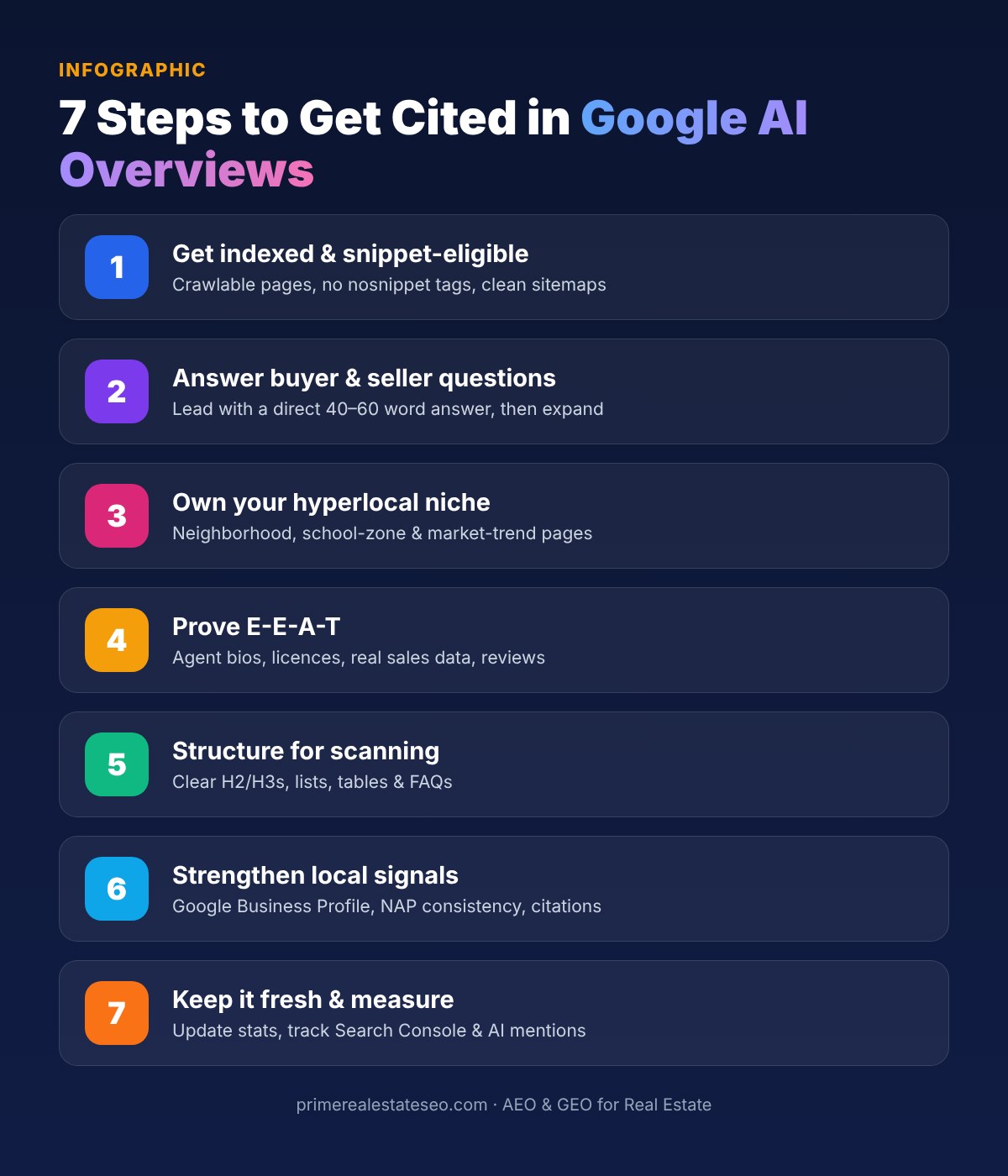
7 Steps to Get Your Real Estate Website Cited in Google AI Overviews
1. Make Sure Your Pages Are Indexed and Snippet-Eligible
First things first: Google can only cite pages it can crawl, index and show with a snippet. So, start with a quick technical health check:
- Confirm key pages are indexed in Google Search Console using the URL Inspection tool.
- Remove accidental
noindex,nosnippetor restrictivemax-snippetdirectives on content you want cited. - Submit a clean XML sitemap and fix broken links, redirect chains and duplicate listing pages.
- Make sure important text sits in the HTML rather than inside images, iframes or the heavy scripts that some IDX plugins rely on.
- Keep your site fast and mobile-friendly, since most property searches happen on phones.
Of course, a well-built site makes all of this easier. Our real estate web development team builds sites with crawlability and speed in mind from day one.
2. Answer Real Buyer and Seller Questions Directly
Questions trigger AI Overviews, so build your content around the questions your clients actually ask. For ideas, look at your own inbox, call notes, Google’s “People also ask” boxes and Search Console query data.
- Use the question (or a close variation) as an H2 or H3 heading.
- Give a clear, direct answer in the first 40–60 words beneath the heading.
- Then expand with detail, local examples, costs, timelines and next steps.
Example: under the heading “How long does it take to sell a house in [City]?”, open with a specific answer drawn from your recent sales, then explain what speeds up or slows down a sale locally.
3. Own Your Hyperlocal Niche
National portals have scale. However, you have something they don’t: real local knowledge. That’s why hyperlocal pages are where independent agents can stand out as the most helpful source:
- Neighbourhood and community guides (schools, commute times, amenities, lifestyle).
- Monthly or quarterly market reports with your own price and days-on-market data.
- Guides for specific audiences: first-time buyers, NRIs, investors, downsizers.
- Explainers on local processes such as stamp duty, registration, property taxes or HOA rules.
As a bonus, this content also strengthens your local rankings. Learn more in our post on how to improve local SEO for commercial real estate, or explore our Local SEO services.
4. Demonstrate E-E-A-T (Experience, Expertise, Authoritativeness, Trust)
Buying or selling a home is a major financial decision. As a result, trust signals carry extra weight in real estate content. So, show Google and your readers that real experts stand behind your content:
- Add author bylines that link to detailed agent bios with licences, designations and years of experience.
- Reference first-hand data: homes sold, average sale-to-list ratios, client case studies.
- Cite reliable sources such as government housing data, RERA or local authority guidance where relevant.
- Display genuine client reviews and keep your details consistent across the web.
Likewise, strong reviews and brand mentions reinforce authority. See our reputation management services for help building them.
5. Structure Content So It Is Easy to Understand
Google has said it doesn’t require special formatting for AI features. Even so, clear structure helps both readers and search systems understand your page:
- Use one descriptive H1, followed by logical H2 and H3 headings.
- Break up long text with bullet points, numbered steps and comparison tables (e.g., “Renting vs Buying in [City]”).
- Add an FAQ section that answers related follow-up questions.
- Use descriptive image alt text and original photos or videos of properties and neighbourhoods.
- Add relevant structured data (such as RealEstateAgent, LocalBusiness, Article or BreadcrumbList) to help Google understand your entities. Accurate markup also supports eligibility for rich results, even though AI Overviews don’t require it.
6. Strengthen Your Local and Entity Signals
For location-based questions, Google looks well beyond your website. In fact, Google’s own guidance encourages local businesses to keep their information current in Google Business Profile, which can support visibility in AI responses.
- Fully complete and regularly update your Google Business Profile with services, areas served, photos and posts.
- Keep your name, address and phone number (NAP) identical across directories and property portals.
- Earn mentions and links from local news sites, community organisations and industry publications.
- Link your website, social profiles and listings so Google recognises your brand as one entity.
Not sure how traditional and local SEO differ? Read the difference between SEO and local SEO for realtors.
7. Keep Content Fresh and Measure Results
Property markets change quickly, and outdated prices or interest-rate figures won’t earn anyone’s trust. For this reason, review your top-performing guides regularly:
- Update statistics, prices and dates, and show a clear “last updated” date.
- Track impressions, clicks and queries in Google Search Console (Search Console includes AI Overview traffic in normal Web search data).
- Manually check your priority questions in Google to see which sources Google cites, and study what those pages do well.
- Finally, watch for branded searches and enquiries that mention finding you on Google.
Common Mistakes That Stop Real Estate Sites Being Cited
- Thin, duplicate listing pages that copy MLS or builder feeds without adding any unique insight.
- Mass-produced AI content that adds nothing new, and Google’s spam policies still apply.
- Generic “real estate tips” posts with no local angle or first-hand experience.
- Locking important information inside images, PDFs or brochures that Google finds hard to read and index.
- Blocking Google with robots.txt rules, noindex tags or nosnippet settings on key pages.
- Ignoring internal links, leaving valuable guides orphaned and hard to discover.
Quick Checklist: Is Your Real Estate Website AI Overview Ready?
| Area | What to Check |
|---|---|
| Indexing | Key pages indexed, no accidental noindex or nosnippet |
| Content | Direct answers to buyer and seller questions, with local depth |
| Trust | Agent bios, credentials, real data, reviews |
| Structure | Clear headings, lists, tables, FAQs, alt text |
| Local signals | Updated Google Business Profile, consistent NAP |
| Freshness | Market data and dates updated regularly |
| Measurement | Search Console tracked, priority queries checked monthly |
Frequently Asked Questions
Can I pay to appear in Google AI Overviews?
No. You can’t buy organic citations in AI Overviews. Instead, you earn them through helpful content and strong SEO. That said, ads can appear in or near AI Overviews in some markets, but those are separate, labelled placements.
Do I need special schema or an llms.txt file to be cited?
No. According to Google, your page only needs to be indexed and eligible for a snippet. Google also says files like llms.txt aren’t necessary. Structured data is still useful for rich results and clarity. However, it isn’t a shortcut to citations.
How long does it take to get cited in AI Overviews?
Unfortunately, there’s no fixed timeline. Generally, sites that already rank well for related queries may see citations soon after publishing strong content, while newer sites usually need several months of consistent SEO and content work.
Will AI Overviews reduce traffic to my real estate website?
Some simple informational queries may get fewer clicks. On the other hand, citations build brand visibility, and the visitors who do click are often more engaged. Focusing on local expertise and lead-generating pages helps offset this shift.
What is the difference between SEO, AEO and GEO?
SEO (search engine optimisation) improves rankings in traditional results. AEO (answer engine optimisation) and GEO (generative engine optimisation) aim to help AI-driven answers, such as Google AI Overviews and AI assistants, choose and cite your content. Ultimately, all three rely on the same foundation: high-quality, trustworthy, well-structured content.
Get Your Real Estate Brand Cited in AI Search
At the end of the day, getting your real estate website cited in Google AI Overviews isn’t about tricks. It’s about being the most helpful, trustworthy and local answer to your clients’ questions, on a technically sound website. Combine strong real estate SEO with consistent, expert content marketing, and you’ll give Google every reason to reference your brand. For more on the bigger picture, read how SEO for real estate helps agents grow their business.
Want a team to handle it for you? Our AEO & GEO services exist specifically to help real estate businesses win visibility in AI-powered search. Contact Prime Real Estates SEO today for a free AI search visibility audit.